
How to Preach Biblically: Guidelines and Common Errors
This last week I attended a Simeon Trust Preaching Workshop at Desert Springs Church in Albuquerque, New Mexico. It was wildly beneficial, and I feel so thankful for all that I learned. I wanted to record what I learned here on my website so that I can refer back to it in the future, but I also hope that it will be beneficial to someone else out there in the early stages of learning how to preach. (I ran out of room – so see part two HERE)
“I charge you in the presence of God and of Christ Jesus, who is to judge the living and the dead, and by his appearing and his kingdom: preach the word; be ready in season and out of season; reprove, rebuke, and exhort, with complete patience and teaching. For the time is coming when people will not endure sound teaching, but having itching ears they will accumulate for themselves teachers to suit their own passions, and will turn away from listening to the truth and wander off into myths.” 1 Timothy 4:1-4
The Preaching Pathway
The Box (Simeon Trust’s concept, not my own). As you can observe in the box pictured below, there is a proper path or journey when it comes to picking up a text and determining how to deliver it (or preach it) to an audience.
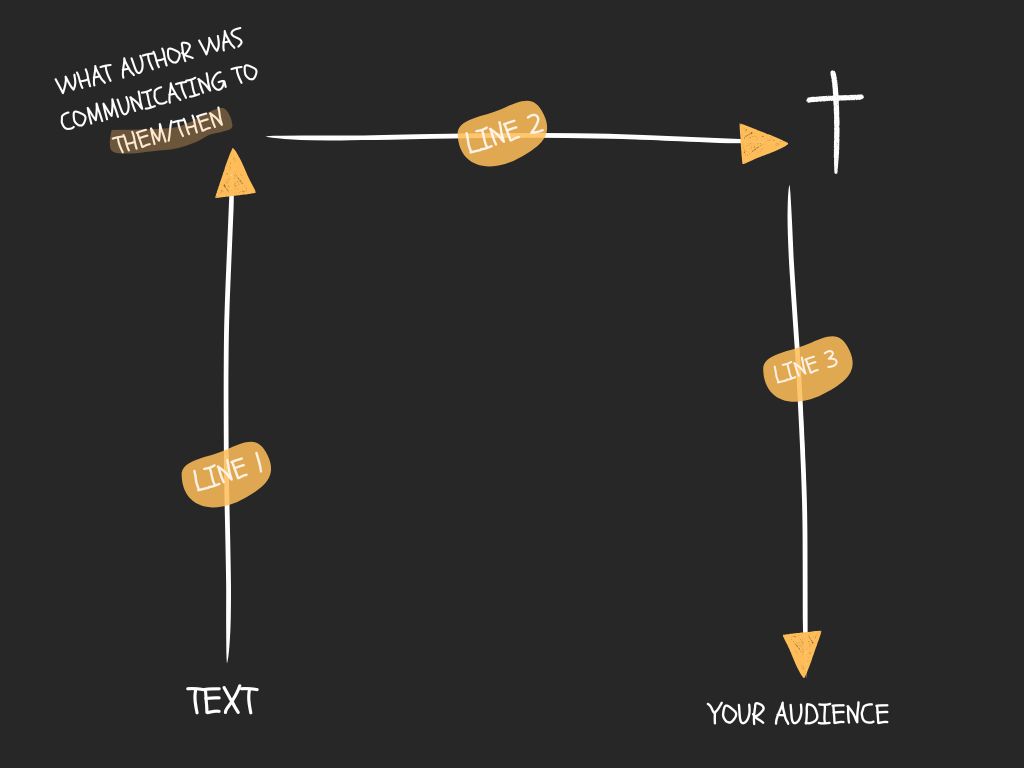
Line #1: This process starts with discovering the message that the original author intended to communicate to his original audience. There are a few tools to discover this message, primarily the structure of the passage, which is the literary structure. This is where the observation stage is so important. You are not making meaning claims. You are simply trying to make objective observations about how the author (both human & divine) structured his writing and information.
The next tool is the Melodic Line, which is the overarching message (or melody – like a through line) of the piece of literature you are dealing with. This will shape the aim and direction of the text you are preaching. Another tool is evaluating the context of your passage, including the literary, cultural, historical, and biblical context. All of these tools are vital to uncovering the meaning of the passage in front of you.
One important note: this process of exegesis, which means pulling meaning out of the text rather than inserting your own meaning into it, assumes that you are preaching a passage of the Bible and not your own opinions with the Bible used as a proof text.
Line #2: This is where one considers how the Gospel impacts or develops the point discovered at the end of Line #1 (top left). I will say more on this in part two because I realized I was doing this completely wrong prior to this workshop. I was often “Jesus-juking” a passage, or better said, “atonement-juking” a passage, always trying to find a way to shove a “Repent!” into the text.
Line #3: This is where we consider how to deliver the message we have discovered in the text and further developed in light of the Gospel to our audience. This line is all about the art of persuasion. It involves developing the argument you are advancing in your message, arranging your material in a helpful way, applying the message to your audience in real and concrete terms, and adorning your message with illustrations and stories that help people feel it and connect with it.
Preaching Pitfalls
This process helps us avoid three primary pitfalls.
The first is preaching that does all its interpretation without considering the original intent and dynamics at play between the author and the original audience. This makes it extremely easy to misinterpret, misapply, and ultimately preach a passage in a way it was never intended to be used. We really do not want to do this as preachers of God’s Word.
The second pitfall is preaching moralistically or legalistically. This means preaching without Christ and the good news of God’s grace shaping our imperatives, which are commands or calls to action. Of course, imperatives and commands still exist in the New Testament, but our religion is not one of earning God’s favor. It is one of living a life of holiness in light of God’s forgiving and empowering grace.
This process (properly progressing through the box) also guards us from the pitfall of overly academic preaching, which simply delivers context to the audience without exhortation or the aim of Gospel transformation. It becomes more like a Sunday School lecture and eventually cultivates followers of Christ with swelled heads and shrunken hearts.
The final pitfall is to overly spiritualize the text, which I like to call “Jesus juking” the text. This approach does not take seriously the message of the passage or the author. It simply moves to a repentance and faith invitation without engaging any moral imperatives or calls to action that exist in the text. It doesn’t shed any light on the meaning of the text past “it all points to Jesus!” To be sure, the whole of Scripture does point to Jesus! But, we often move quickly past explaining the text in front of us with a simplistic gospel connection and do a disservice to those in front of us.
Exhortation
One of the things that stood out to me most is that this style of preparation and preaching takes far more work than simply developing a nicely structured sermon with a thesis and three points. Often we use a text and preach things that are true, but we do not actually preach the text. I am extremely guilty of this. We use the text more as a diving board than as the guide or pathway for what exactly we’re going to say.
One of our instructors encouraged us with this example. Imagine inviting some friends over for a football game and telling them you are going to make brisket. When they arrive, you suddenly commit a heinous sin and throw the brisket in the microwave! The problem is that brisket, like biblical/expository preaching, cannot be microwaved. It takes prayerful labor over an extended period of time to truly discover what God has said, and is saying, through the portion of Scripture that lies before you.
Recommended Resources:
- Expository Preaching by Ed Helm
- Christ Centered Preaching by Bryan Chapell
- Simeon Trust Online Courses https://simeontrust.org/online-courses/